In North Carolina, you choose the body shop, not your insurer
After a crash, your insurer may hand you a list of preferred shops. Here's what North Carolina law actually says about who decides where your car gets fixed.
The short answer
You do. Under N.C. Gen. Stat. 58-3-180, an auto policy must let the claimant choose the repair shop. An insurer may recommend one, but it has to tell you that you don't have to use it, that you can go anywhere you like, and that it will pay the same amount either way. It also can't require an insurer-owned shop.
Right after a crash, many drivers get the same call or app message from their insurance company: here are a few shops we work with, which one would you like? It can sound like a requirement. In North Carolina, it isn't.
This post walks through what state law says, what your insurer can and can't do, and how estimates and supplements work when you pick your own shop. It's written for drivers, not lawyers, so read it as a plain-language overview rather than legal advice.
What North Carolina law says
The rule is N.C. Gen. Stat. 58-3-180, titled "Motor vehicle repairs; selection by claimant." Its first subsection is short: a policy that covers damage to a motor vehicle has to allow the claimant to select the repair service.
The rest of the section fills in the details:
- The payment doesn't depend on your choice. The amount the insurer determines it owes has to be paid no matter which shop you select.
- Recommendations come with disclosures. An insurer can recommend a shop, but only if it clearly tells you that you're under no obligation to use it, that you can use the shop of your choice, that the amount payable is the same either way, and about any financial interest it has in the recommended shop.
- No insurer-owned shop requirement. An insurer can't require you to have the car repaired at a shop it owns.
- It covers the people you actually talk to. The rules apply to "insurer representatives," which the statute defines to include insurance producers (agents), limited representatives, adjusters and appraisers.
A violation can lead to enforcement by the NC Department of Insurance, including a civil penalty of up to $2,000 under G.S. 58-2-70(d). In November 2024, Insurance Commissioner Mike Causey sent a memo to insurers and their representatives reminding them of exactly these disclosure requirements.
The right applies whether you're claiming under your own policy or against the other driver's liability coverage. The Department of Insurance's consumer guidance says that in either case the insurer may recommend a shop, but you have the right to select the shop of your choosing.
What your insurer can and can't do
Knowing the limits on both sides keeps the conversation calm. Your insurer can:
- Recommend shops, as long as it gives the disclosures above.
- Inspect the damage, in person or through photos and video, and write its own estimate.
- Decide the amount it believes the policy owes, subject to the dispute options covered below.
- Inspect again when a shop finds more damage.
Your insurer can't:
- Require you to use a particular shop, including one it owns.
- Pay a different amount because you didn't use its recommended shop.
- Require aftermarket parts unless they're equal to the original part in fit, quality, performance and warranty, according to the Department of Insurance. Any modifications needed to make those parts fit have to be included in the estimate.
What a direct repair program shop is
Many insurers keep a network of shops they've signed agreements with. You may hear it called a direct repair program (DRP), a preferred shop list or a network shop. The details vary by company, but in general the shop agrees to follow the insurer's procedures and guidelines, and the insurer refers customers to it.
There's nothing wrong with a network shop, and plenty of people use one and are happy with it. The point is that it's an option, not an obligation. A network shop has an ongoing relationship with the insurer. A shop you choose yourself still deals with your insurer on the claim, but you picked it.
A few questions worth asking yourself before you decide:
- Do I already know a shop I trust, or does someone I trust recommend one?
- Is the shop convenient to where I live and work?
- Does the shop handle the work my car needs, such as structural collision repair or color-matched refinishing?
- Will the shop explain the estimate to me and keep me updated?
How to tell your insurer you picked your own shop
You don't need anyone's permission, and you don't need to argue. A short, clear statement works best.
- Report the claim and get the claim number. Write down your adjuster's name and the best way to reach them.
- Name your shop. Something like, "Thanks for the list. I'll be using my own shop," followed by the shop's name, address and phone number.
- If the network pitch comes up again, say it once more. "I understand I'm not required to use your recommended shop, and I'd like to use mine." That's the whole conversation.
- Ask how the inspection will happen. North Carolina's claim rules call for the insurer to do a physical or digital inspection within 10 business days of receiving the claim, or to explain the delay. If you want someone to look at the car in person, ask. The rules say an insurer can't refuse a physical inspection when you request one.
- Keep everything in one place. Save emails, texts, photos and estimates in a single folder.
If you choose us, give your adjuster our name and number, Kustom Shop at 910-309-8011, and we'll work with the insurer on the estimate. Our insurance claims page explains how that process usually goes.
You don't have to collect a stack of estimates, either. Under the same state rules, if an insurer requires you to get more than two estimates, the insurer pays for the additional ones.
The estimate, the teardown and supplements
The first estimate on a collision claim is usually written from what can be seen on the outside. That's a reasonable starting point, but modern cars hide a lot behind the bumper cover and under the hood: brackets, reinforcement bars, sensors, cooling parts and mounting points.
Once a shop removes the damaged parts, it often finds more. When that happens, the shop documents the added damage and sends the insurer a supplement, which is an addition to the original estimate. The insurer reviews it, sometimes with another inspection, and approves the added work it agrees is owed.
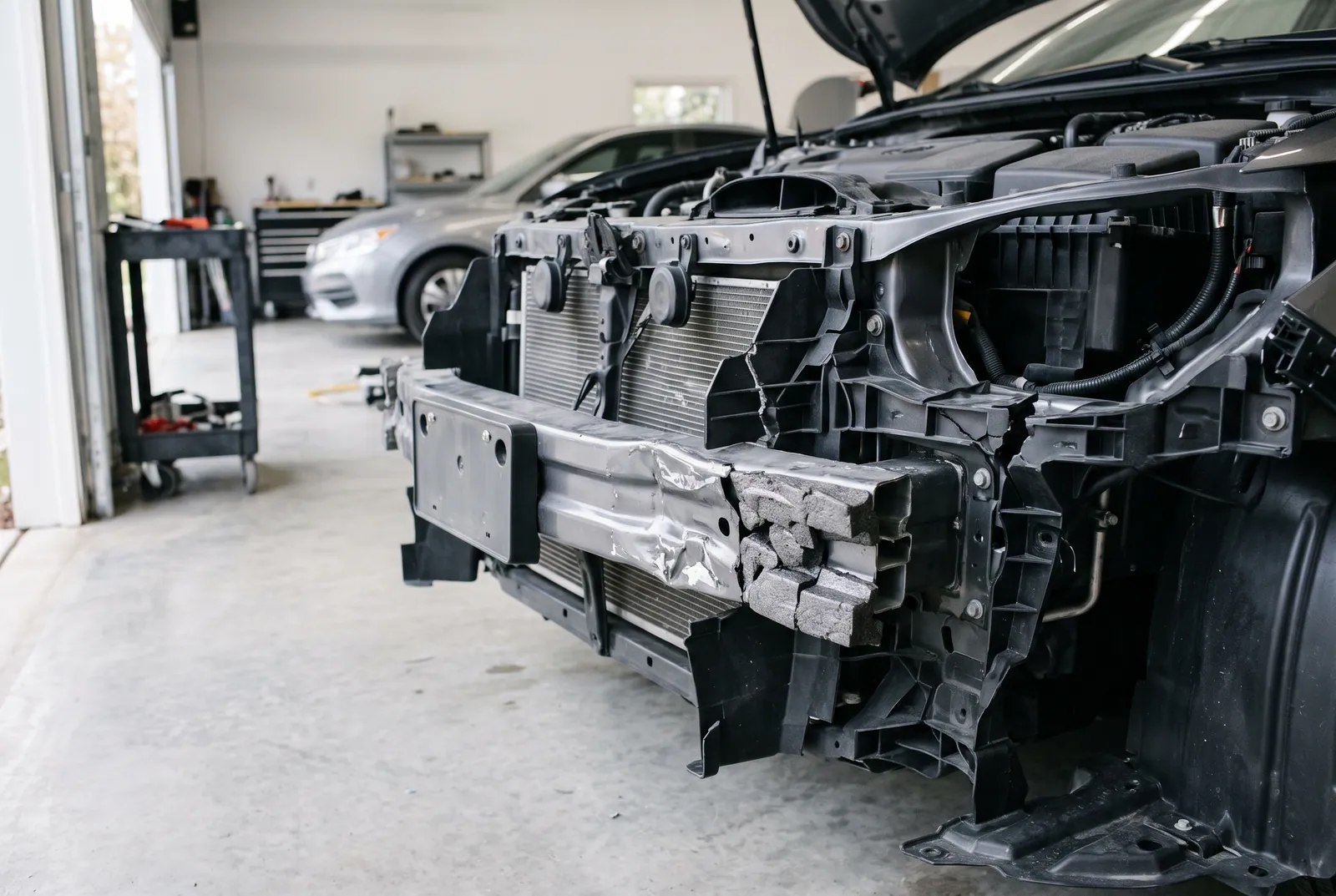
North Carolina's rules include a few protections for this stage:
- If there's a delay in responding to a request for a supplemental inspection, the insurer has to give you a verbal or written explanation.
- If you ask, the insurer has to give you copies of the original estimate and every supplemental estimate.
- Supplements count toward the total-loss line. A car is treated as a total loss when its damage, including original and supplemental claims, reaches 75 percent of its pre-accident actual cash value. The rules also prohibit agreements to hold supplements down just to keep a repair under that line.
Supplements are a normal part of collision repair, not a sign that something went wrong. What matters is that hidden damage gets found, documented and repaired correctly. Our collision repair page covers the kinds of damage we fix.
If you and the insurer don't agree on the amount
Most differences between a shop's estimate and an insurer's estimate get worked out between the shop and the adjuster, line by line. If that doesn't settle it, the Department of Insurance describes two paths, depending on whose policy you're claiming under.
- Your own policy (first party). Your policy has an appraisal provision. You and the insurer each choose an appraiser, the two appraisers choose an umpire, and a decision by any two is binding. Each side pays its own appraiser, and you split the remaining appraisal and umpire costs equally.
- The other driver's policy (third party). You can work with that company's appraiser to reach an agreement, or file under your own collision or comprehensive coverage, if you carry it, and let your insurer recover the money from the other company.
If you believe an insurer steered you toward a shop without the required disclosures, or your claim has stalled, you can call the NC Department of Insurance Consumer Services Division at 855-408-1212.
The short version
It's your car and your choice. An insurer can suggest a shop, but it has to tell you that you're free to go elsewhere and that the payment won't change. Pick the shop you trust, tell your adjuster once, keep your paperwork together, and expect a supplement or two along the way.
If you've just been in a wreck and aren't sure what comes first, our checklist for after a crash in Fayetteville covers the scene, the police report and the claim. When you're ready, send photos through our free estimate form.
Questions
Can my insurance company pay less if I don't use its preferred shop?
No. North Carolina law says the amount the insurer determines is payable under the policy has to be paid regardless of which shop you choose. Differences between your shop's estimate and the insurer's estimate are a separate question, usually worked out between the shop and the adjuster.
Does the right to choose apply when the other driver's insurance is paying?
Yes. The NC Department of Insurance says that whether you claim under your own policy or against another driver's liability policy, the insurer may recommend a shop, but you have the right to select the shop of your choosing.
Do I need three estimates for a car insurance claim in North Carolina?
Not necessarily. Under the state's claim rules (11 NCAC 04 .0419), if an insurer requires more than two estimates of the damage, the insurer has to pay for the additional ones. Ask your adjuster what they actually need before you start collecting more.
What if my car is totaled but I want to keep it?
The NC Department of Insurance says you have the right to keep the salvage vehicle. The insurer then deducts the salvage value from the actual cash value it pays you, and if you ask, it has to give you the name and address of a salvage dealer who would buy the salvage for the amount deducted. If you're thinking about repairing a car that was totaled, get a repair estimate before you decide.
Sources
- G.S. 58-3-180: Motor vehicle repairs; selection by claimant (North Carolina General Assembly)
- RE: NCGS 58-3-180, recommending the use of a particular repair service or source (steering) (NC Department of Insurance)
- After an Accident (NC Department of Insurance)
- 11 NCAC 04 .0419: Motor vehicle repair estimates (NC Office of Administrative Hearings)
- 11 NCAC 04 .0418: Total losses on motor vehicles (NC Office of Administrative Hearings)
Need it looked at?
Send a few photos for a free estimate from Kustom Shop, 5409 Bragg Blvd, Fayetteville, NC 28303. With or without insurance.